

High-index optical fibers are specialty fibers engineered with a core refractive index that is intentionally higher than that of conventional single-mode transmission fibers. This is achieved by precisely controlling dopant profiles in the glass preform, most commonly with germanium or other index-raising materials. Due to this elevated refractive index, high-index fibers support tighter optical confinement, altered mode field diameters, and tailored numerical aperture characteristics compared to standard telecom fibers.
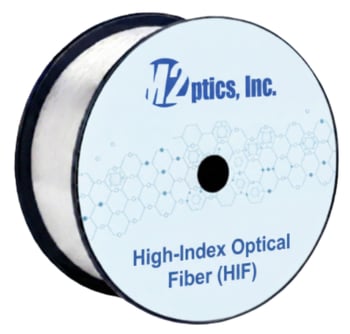
From a physics standpoint, the higher core index increases the index contrast between the core and cladding. As a result, light is more strongly guided within the core, which directly affects propagation behavior, bend sensitivity, cutoff wavelength, and dispersion characteristics. These properties are not incidental. They are deliberately exploited in applications where optical control, rather than long-haul transmission efficiency, is the primary design objective.
One of the most common technical applications of high-index fibers is to improve mode-field management when mode-matching or mode-conditioning is required between dissimilar optical components. For example, when light is transmitted between lasers, amplifiers, sensors, or dissimilar fiber types having different mode field compositions, the mismatched mode fields can introduce excess loss and instability. High-index fibers allow engineers to bridge those gaps with predictable optical behavior.
How and Where are Hi-Index Fibers Used Most?
High-index fibers are also widely used in fiber-based devices, components, and assemblies where compactness and optical precision matter. Examples include fused fiber-optic couplers, fibers within erbium-doped fiber amplifiers (EDFAs), interferometric sensors, fiber lasers, gyroscopes, and other specialized components. In these systems, tighter confinement demands shorter lengths, reduced sensitivity to microbending, and improved control over polarization or phase stability.
Entities and market sectors that regularly utilize high-index optical fibers include aerospace and defense, where compact sensing and navigation systems are critical, as well as industrial sensing, medical diagnostics, and scientific research. They are also common in photonics laboratories and OEM component and device manufacturing, particularly in laser delivery systems, optical components, and test instrumentation, where they are more suitable than standard telecom fibers, which may not be as optically compatible or deliver the required performance results.
Who Manufactures Hi-Index Optical Fibers?
Several large global manufacturers offer high-index optical fibers in their portfolios, as do smaller, reputable specialty fiber manufacturers. Corning’s High-Index fibers (ex: HI 980, HI 1060, etc) are popular, while Lightera (OFS) also produces comparable high-index fibers designed for device integration and sensing. Nufern, now part of Coherent, supplies high-index fibers optimized for laser and amplifier platforms, while other specialty fiber manufacturers offer these fibers with customized index profiles and other characteristics for supporting niche applications, often in limited or project-based production runs.
M2 Optics - Your Partner for Customized, High-Index Optical Fiber Solutions
At M2 Optics, high-index fibers are available in precise, user-specified lengths and configurations for network & latency simulation testing, optical time delay, training, and device demonstration applications. Additionally, M2 also provides optical components utilizing high-index fibers for specialized project requirements. If your testing or networking applications need controlled mode propagation, non-standard coupling, lab-grade optical accuracy, or a specific brand of high-index fiber, contact M2 Optics to learn more and begin designing your customized solution.
For more information, contact M2 about High-Index Fibers.