

As unmanned aerial systems continue to evolve, one category is attracting increasing attention, particularly in defense and surveillance circles: the tethered fiber optic drone. While most people are familiar with wireless drones that rely on radio frequency links for control and data, tethered fiber optic drones take a fundamentally different approach by replacing wireless RF communications with a physical optical fiber connection.
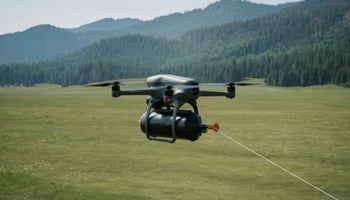
At its core, a tethered fiber optic drone is an unmanned aerial vehicle (UAV) that remains connected to its ground-based operator via a thin strand of optical fiber. This fiber is not used for power delivery, as is common with some other tethered devices, but specifically for communications. Control signals, telemetry, and high-bandwidth video are transmitted using light signals rather than radio waves. As a result, the drone is controlled with a direct, closed connection to its operator.
How the Technical Setup Works
The defining feature of a tethered fiber optic drone system is easy to spot - the onboard fiber canister attached to the drone. Inside this compact enclosure is a precisely wound spool of bare optical fiber. As the drone lifts off and moves through its flight path, the fiber consistently pays out from the canister in real time. Since the fiber is wound onto the reel under controlled tension, it remains on the reel inside the canister until the stronger tension of drone movement initiates the payout, ensuring reliable signal transmission without interfering with flight dynamics.
On the ground, the fiber connects to the operator's control and monitoring equipment. Because the fiber itself carries the data stream, there is no reliance on antennas, transmitters, or spectrum availability. The result is a deterministic communications link that serves in the same way as a direct cable connection, rather than a wireless one.
In terms of the optical fiber itself, it is typically unjacketed or non-cabled, referred to as bare optical fiber. While manufactured with a small layer of protective coating, standard bare optical fibers are typically 250um or 200um in diameter. While these may be used as-is for tethered drone connections, the fiber may include an additional protective coating for increased durability, resulting in a larger diameter, such as 400um. In some of the latest tether innovations, protective materials like Kevlar are being infused into the coating for even greater durability. To achieve communication over distances beyond a few hundred meters, single-mode optical fiber is used due to its long-range transmission properties.
How Fiber Optic Drones Differ from Wireless RF Drones
Wireless drones depend on RF signals that propagate through the air. While this enables long-range and more versatile operation, it also introduces vulnerabilities. RF signals can be detected, jammed, intercepted/hacked, or degraded by terrain and environmental conditions. In contrast, communications transmitted through a fiber optic tether are not detected using RF identification systems, cannot be intercepted without physically accessing the fiber itself, and are immune to electromagnetic interference. Similar to why hard-wired CCTV systems are still the preferred solution for surveillance applications when malicious wireless hacking and jamming are a concern, tethered fiber optic drone communications deliver comparable benefits.
This physical optical fiber connection fundamentally meets the operator's needs with added benefits. Data rates are more consistent and predictable, high-quality video feeds and instantaneous control are supported, and optical fiber consistently delivers low-latency performance. From a control perspective, the operator/pilot experiences a consistent and responsive connection regardless of RF congestion or electronic countermeasures.
Primary Benefits of a Physical Fiber Connection
Simple and straightforward, the most significant advantage of the fiber optic tether is security. Optical fiber does not radiate energy, meaning the drone is effectively silent from an RF detection standpoint, which is often a main focus of air defense and detection systems. This makes it especially valuable for contested, battlefield, and covert use, where mitigating drone detection or interference is essential.
Reliability is another major benefit. Fiber connections are not affected by weather, multipath fading, or spectrum congestion. This leads to consistent communication and high-quality data delivery, even in complex urban or indoor environments.
Common Applications and Use Cases
Tethered fiber optic drones are increasingly used in tactical military operations where secure communications, covert operations, and detection avoidance are critical. They are well-suited for tactical military offensive operations, reconnaissance, surveillance, and intelligence gathering in environments where RF detection and denial are expected.
Law enforcement and security teams also use these systems for persistent observation in sensitive areas, including activity monitoring, facility security, and hostage situations.
In all use cases, their ability to ensure secure, interference-free, quality communication provides a clear operational advantage.
Tradeoffs and Drawbacks to Consider
While fiber-tethered drones offer several important benefits over wireless drones, several disadvantages and challenges are a reality. The primary drawbacks of fiber-optic drones include: flight distance limitations, the extra weight of the attached fiber canister, fiber supply and manufacturing contraints, and the risk of losing communication (and the drone) entirely if the fiber is severed or damaged during flight.
The maximum flight distance of a tethered fiber optic drone is limited to the total length of fiber in the attached canister. While some advanced manufacturers of these fiber tether canisters have shown an ability to efficiently achieve maximum distances of 20~40km, many wireless drones are capable of flying much longer distances. This makes fiber-optic drones less suitable for longer-range missions that require wide-area coverage. Careful mission planning is essential to balance range, payload, and fiber capacity.
Another challenge is the added weight of the attached fiber and canister hardware. Carrying extra weight increases a drone's power requirements and shortens its battery life, reducing its maximum flight time. Additionally, greater weight negatively impacts total potential drone speed. For military attack and supply drones that carry a payload plus the fiber canister, reducing the fiber canister weight as much as possible is always a priority.
One of the biggest challenges many entities face, often unmentioned, is a lack of consistent access to high-quality bare optical fibers from a supply chain perspective. Optical fiber serves as the backbone of global communications and is experiencing continued rapid growth in demand. Sourcing bare fiber from major reputable manufacturers and in the volumes required is extremely limited, or not even an option for most entities without a pre-established, formal sourcing relationship. Many drone users and their entities have also implemented material supply mandates, such as requiring all materials to be produced domestically, further reducing procurement options. Aside from fiber supply challenges, successfully designing and producing tethered drone fiber canister solutions requires highly specialized manufacturing equipment, processes, and staff expertise that most entities lack.
Lastly, since tethered fiber optic drones are 100% reliant on maintaining the physical fiber connection, if the fiber is cut entirely or sustains significant damage during flight, the operator will lose communication and control, and the drone will be lost.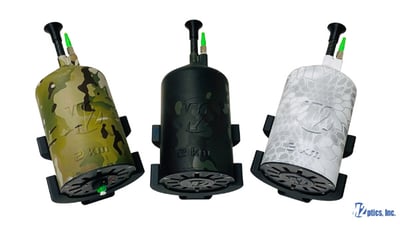
Learn More about Tethered Fiber Optic Drone Technology - Contact M2 Optics
For more than two decades, M2 Optics has been the recognized leader in designing and manufacturing customized, spooled bare optical fiber solutions for essential communications applications. Building on this deep expertise, the company’s 100% customized and US-manufactured OptiTetherTM drone canister tether solutions represent the latest game-changing innovations for this industry.
For more information or to partner with M2 to design an OptiTetherTM canister customized to your exact needs, contact us today.